
The ‘Upload and Pray’ Trap: Why Your KDP Books Aren’t Selling and How to Fix It
KDP BasicsDecember 26, 2025•16 min read
—
Understanding the ‘Upload and Pray’ Phenomenon
The “Upload and Pray” strategy is the silent killer of thousands of KDP accounts. It occurs when an author pours their energy into content creation, uploads the file, and simply hopes the Amazon algorithm will magically find them an audience. In today’s algorithmic landscape, hope is not a strategy; it is a liability. To fix a stagnant book, you must first understand the environment you are publishing into.
The KDP Saturation Myth vs. Reality
It is easy to look at the millions of titles on Amazon and claim the market is “saturated.” This is a half-truth. KDP is indeed saturated with noise—low-quality, unedited, and poorly formatted books. However, it is not saturated with professional-grade solutions. You are not competing against 10 million books; you are competing against the top 20 titles in your specific niche. If you produce quality, the competition is significantly thinner than the raw numbers suggest.
Why High-Volume Publishing is No Longer Enough
In 2015, the “spaghetti method”, throwing hundreds of low-quality books at the wall to see what sticks, was a viable tactic. Today, it is algorithmic suicide. Amazon’s A9 algorithm prioritizes conversion history and customer engagement. A catalog full of books that garner impressions but zero clicks signals to Amazon that your content is irrelevant. One high-converting asset is now infinitely more valuable than 100 dormant titles.
The Shift from Hobbyist to Professional Publisher
The primary differentiator between an author making pennies and one making a living is mindset. The hobbyist views a book as a creative project; the professional views it as a product. Moving away from “Upload and Pray” requires treating your KDP account like a business. This means validating ideas before writing, investing in professional packaging, and analyzing data rather than relying on intuition.
Defining the Search Intent of Your Target Reader
Finally, curing the “Upload and Pray” syndrome requires a pivot from keywords to intent. It is not enough to rank for “Intermittent Fasting.” You must understand why the reader is searching for it. Are they looking for a scientific textbook, a beginner’s guide, or a cookbook? If your cover and content do not align with the specific problem the reader is trying to solve, even the best SEO will fail to generate sales.
Phase 1: Market Research (Finding the Why)
If your dashboard is flatlining, it is rarely due to bad luck. It is almost always a lack of market validation. The “Upload and Pray” method fails because it assumes that supply creates demand. In the Amazon ecosystem, you must identify existing demand and position yourself in its path. Before you tweak a cover or rewrite a blurb, you must diagnose the fundamental health of your niche.
Why Am I Not Making Sales on KDP? Diagnosing the Niche
The uncomfortable truth is that you may have written a book nobody is searching for, or entered an arena so crowded that your book is invisible on page 50. To fix this, you must treat your book as a product. Ask yourself: Is there existing traffic for this topic? If you cannot find similar books making money, you have found a “ghost town.” Conversely, if there are 50,000 results and the top books are by celebrities, you are in a “war zone.” The goal is to find the sweet spot between the two.
Analyzing the Best Seller Rank (BSR) of Your Competitors
Amazon tells you exactly what is selling through the Best Seller Rank (BSR). This number, found in the “Product Details” section of every book page, is the pulse of your market. You must analyze the top 10 books in your target keyword.
-
BSR under 100,000: The book is selling consistently (3–10 copies a day). This indicates healthy demand.
-
BSR over 1,000,000: The book is barely selling (maybe once a month). If your competitors all look like this, stop. There is no buyers’ intent here.
Your goal is to find a keyword where the top competitors have a BSR between 10,000 and 100,000. This proves customers are buying, but the competition isn’t insurmountable.
Identifying Content Gaps in Overcrowded Markets
If a market is profitable but crowded, you cannot simply copy the bestsellers. You must innovate. The secret weapon here is mining negative reviews. Look at the 2-star and 3-star reviews of the top books in your niche. What are readers complaining about?
-
Is the print too small?
-
Is the information outdated?
-
Is the tone too academic?
These complaints are your Unique Selling Proposition (USP). If a bestseller on “Indoor Gardening” is criticized for lacking photos, your book must be “The Fully Illustrated Guide to Indoor Gardening.” Fill the gap they left behind.
The Power of Micro-Niching to Dominate Sub-Categories
When you cannot compete on a broad keyword, you must micro-niche. A general “Cookbook” will never rank. However, “Plant-Based Meal Prep for College Students” has a specific audience with less competition.
By drilling down, you reduce the pool of competitors from 50,000 to 500. It is better to be a big fish in a small pond than a minnow in the ocean. Dominating a micro-niche spikes your sales velocity, which signals the Amazon algorithm to eventually promote you to broader categories.
Phase 2: Visual Authority and First Impressions
You can have the most profound manuscript or the most helpful low-content logbook in the world, but if your visual presentation fails, your book effectively does not exist. In the Amazon ecosystem, your book is a product, and the cover is its packaging. Before a customer ever reads your description or checks your price, they must be visually persuaded to stop scrolling.
The 3-Second Rule: Why Your Cover is Your Best Marketing Tool
Amazon customers are speed-browsers. You have approximately three seconds to capture attention as a potential buyer scans a search results page populated by dozens of competitors. Your cover has one primary job: immediate genre signaling.
If a customer is looking for a sci-fi thriller, your cover must communicate “sci-fi thriller” before they even read the title. If they have to guess what your book is about, you’ve already lost the sale. Your cover isn’t just art; it is a high-stakes promise of the experience contained within.
Common DIY Design Mistakes That Scream ‘Amateur’
The “Upload and Pray” method often relies on hasty, DIY cover design, which is the fastest way to kill conversion rates. To establish Visual Authority, avoid these KDP killers:
-
Illegible Typography: Placing white text on a light background or using overly decorative script fonts that are unreadable at a glance.
-
The “Clutter” Effect: Trying to fit too many elements, symbols, or characters onto the front. Professional covers rely on a single, strong focal point.
-
Poor Stock Image Blending: Using generic stock photos without color grading or lighting adjustments makes the book look like a school project rather than a professional publication.
Optimizing Your Title and Subtitle for Both Humans and Robots
Your textual metadata serves two masters. The Title is for the human; it should be catchy, memorable, and legible on the cover. The Subtitle is largely for the robot (the Amazon Algorithm), though it must still make sense to readers.
Use your subtitle to inject the high-traffic keywords you identified in Phase 1. For example, a title like “Green Thumb” tells the human the theme, but the subtitle “The Complete Guide to Urban Gardening and Hydroponics for Beginners” tells the A9 algorithm exactly when to show your book in search results.
Thumbnail Testing: Does Your Book Stand Out on a Mobile Screen?
Over 50% of Amazon traffic comes from mobile devices. A cover that looks beautiful on your 27-inch monitor may turn into an indiscernible blob on an iPhone screen.
Before finalizing your design, perform the Squint Test. Shrink your cover down to thumbnail size (roughly 100 pixels wide). Can you still read the title? Is the central image distinct? If your cover loses its impact at thumbnail size, it will fail to generate clicks. High contrast and bold typography are not just stylistic choices; they are mobile-first necessities.
Phase 3: Mastering KDP SEO and the Amazon Algorithm
You have a compelling cover and a validated market, but without visibility, your book is effectively invisible. The “Upload and Pray” strategy fails because it ignores the fundamental nature of Amazon: it is a search engine first and a store second. To escape the trap, you must speak the algorithm’s language.
Maximizing the 7 Backend Keyword Slots
Many authors waste the seven backend keyword slots by inputting single words like “thriller” or “cooking.” This is a massive missed opportunity. Each slot allows for up to 50 characters (depending on the marketplace). The algorithm doesn’t require commas or logical phrasing; it looks for broad match relevance.
Instead of single words, use long-tail phrases to fill the character limit. For example, rather than just “productivity,” use “time management strategies for procrastination and focus.”
-
Do not repeat words found in your title, subtitle, or author name (Amazon already indexes those).
-
Do not use competitor author names (this violates T&C).
-
Do use tools like Publisher Rocket or Helium 10 to identify phrases with high search volume but lower competition.
Category Ninja Tactics: Moving Beyond the Default Options
Being a small fish in a massive pond—like “General Fiction”—is a recipe for obscurity. To achieve the coveted Best Seller Flag, you need to dominate a specific sub-niche. While KDP limits the number of categories you can select in the dashboard, you must drill down to the deepest possible relevance.
Don’t settle for the top-level options. Look for the “leaf nodes”—the end of the category branch. For a sci-fi book, avoid “Science Fiction > General.” Aim for “Science Fiction > Cyberpunk” or “Dystopian > Genetic Engineering.” Ranking #1 in a smaller category provides social proof that signals the algorithm to push you into broader visibility.
The Impact of A+ Content on Conversion Rates
Once SEO gets a reader to your page, A+ Content is what convinces them to stay. This feature allows you to replace the standard text description with rich graphics, comparison charts, and brand storytelling.
On mobile devices, which account for the majority of Amazon traffic, the description is collapsed, but A+ Content renders fully. This provides two critical benefits:
-
Visual Authority: It mimics the experience of flipping through a physical book.
-
Ad Suppression: It physically pushes the “Products related to this item” (competitor ads) further down the page, keeping the reader focused on your book. Data suggests adding A+ content can increase conversion rates by up to 5-10%.
How Amazon Uses ‘Recent Sales History’ to Rank Your Book
The Amazon algorithm is recency-biased. It cares less about your total lifetime sales and more about your sales velocity how many units you have moved in the last week, day, and hour.
This is the mechanism behind the Best Sellers Rank (BSR). A book that sold 100 copies three years ago will rank lower than a book that sold 10 copies today. To maintain visibility, you cannot rely on a single launch spike. You must feed the algorithm consistent sales data. If your sales velocity drops to zero, your book falls into the “abyss,” losing its keyword ranking positions. Consistent traffic (discussed in Phase 5) is the fuel that keeps the algorithm working in your favor.
Phase 4: Sales Copy that Converts (The Blurb)
If your cover’s job is to stop the scroll, your book description’s job is to close the sale. A common symptom of the “Upload and Pray” method is a high Click-Through Rate (CTR) on ads but a low Conversion Rate (CR). This indicates that people are interested in your concept, but your sales copy failed to convince them to part with their money.
To fix this, you must stop summarizing your book and start selling the experience or the result.
The Hook-Problem-Solution Framework for Non-Fiction
Non-fiction readers buy solutions, not just information. To convert browsers into buyers, structure your blurb using the HPS Framework:
-
The Hook: Start with a provocative question or a startling statistic that aligns with the reader’s current reality.
-
The Problem: Agitate the reader’s pain points. Describe their frustration vividly so they feel understood.
-
The Solution: Present your book as the specific vehicle for transformation. Don’t just list what is in the book; list what the reader will become after reading it.
Emotional Trigger Points in Fiction
Fiction requires a different approach. You aren’t solving a problem; you are selling an emotional journey. Avoid dry plot summaries that read like a Wikipedia entry. Instead, focus on the stakes:
-
Introduce the Protagonist: Who are they, and why do we care?
-
The Inciting Incident: What disrupts their life?
-
The Conflict: What stands in their way?
-
The Stakes: What happens if they fail?
Your goal is to leave the reader on a cliffhanger that can only be resolved by clicking “Buy Now.”
Using Formatting and HTML to Improve Readability
Amazon’s default text editor often turns descriptions into unappealing “walls of text.” A confused mind says no. Though it has gotten better in recent years, for the best result, you must use HTML formatting to create visual hierarchy.
Use bold tags to highlight your hook and key benefits. Use bulleted lists to break up density. Ensure you have distinct paragraph breaks. There are free KDP HTML description generators available online use them to ensure your description looks professional and scannable on mobile devices.
The Importance of Social Proof and Editorial Reviews
The “cold start” problem occurs when a book has zero reviews. Readers hesitate to be the first to jump. However, you can populate the Editorial Reviews section via Author Central immediately, without waiting for organic customer purchases.
Place accolades, quotes from beta readers, or praise from influencers in this section. By manually adding social proof, you signal to the algorithm and the reader that this book is vetted, trusted, and worth the investment.
Phase 5: Traffic Generation and Advertising Strategies
You have optimized your metadata and polished your cover, but your book is effectively invisible. This is where the “Upload and Pray” method fails most spectacularly. You cannot wait for organic sales to trigger the algorithm; you must force the algorithm to take notice through sales velocity. To do this, you need a strategic traffic engine.
Introduction to Amazon Advertising (AMS) for Beginners
Think of Amazon Ads (AMS) not as an expense, but as a data-gathering tool. For beginners, the most effective entry point is Sponsored Products. Start with an Automatic Targeting campaign with a low daily budget ($5.00) and conservative bids ($0.30–$0.40). Allow Amazon’s AI to test your book against various customer search terms.
After two weeks, download your Search Term Report. This report reveals exactly which keywords led to sales. You then take these winning keywords and move them into a Manual Targeting campaign, where you have full control over the bidding. This “mining and refining” cycle is the cornerstone of profitable AMS.
The ‘Cold Start’ Problem: How to Get Your First 10 Reviews
Traffic without social proof is a waste of money. A shopper who clicks your ad but sees zero reviews will likely bounce. Before turning on ads, you must solve the “Cold Start” problem.
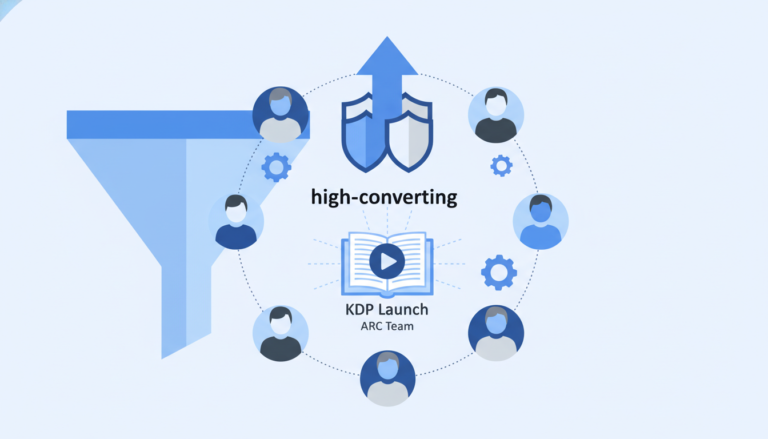
Do not ask friends and family, as this links your account to non-target buying habits. Instead, build an ARC (Advance Review Copy) Team. Use platforms like BookSprout, StoryOrigin, or specialized Facebook groups to offer a free digital copy of your book in exchange for an honest review. Aim for at least 10 verified reviews during launch week to establish credibility.
External Traffic: Leveraging Social Media and Newsletter Swaps
While AMS captures people already on Amazon, external traffic brings fresh eyes that the algorithm loves. You don’t need to dance on TikTok to sell books. Focus on Newsletter Swaps via platforms like BookFunnel. By promoting another author’s book to your email list in exchange for them promoting yours, you tap into an audience of warm, active readers.
Understanding ACoS and Scaling Your Winning Ads
Success in advertising comes down to ACoS (Advertising Cost of Sales). If you spend $4 to make $10 in sales, your ACoS is 40%.
During your launch, profit is not the primary goal—ranking is. You may run a high ACoS (breaking even or taking a small loss) to spike your Best Sellers Rank (BSR). Once your book ranks organically, you optimize for profit by pausing non-converting keywords and slowly increasing bids on keywords with an ACoS lower than your profit margin. Scale slowly; aggressive scaling can confuse the algorithm and kill your momentum.
Phase 6: The 30-Day KDP Recovery Roadmap
You have identified the flaws in your strategy and learned the mechanics of the Amazon algorithm. Now, it is time to move from “upload and pray” to “strategic intervention.” This 30-day roadmap is designed to resuscitate a dormant backlist and turn dead files into revenue-generating assets.
Step 1: The Catalog Audit and Data Analysis (Days 1–7)
Before changing a single pixel, you must diagnose the specific point of failure. Stop guessing and look at your KDP Reports and Advertising dashboard. Categorize your books based on two specific metrics:
-
High Impressions, Low Clicks: Your cover or title is failing to hook the reader. The market sees you, but they aren’t interested.
-
High Clicks, Low Sales: Your traffic is healthy, but your “Look Inside,” description, or price point is killing the conversion.
Create a spreadsheet identifying your top three underperforming assets with the highest potential and prioritize them.
Step 2: The Optimization Sprint (Days 8–14)
Focus strictly on the assets prioritized in Step 1. This is the metadata and visual overhaul phase. If your audit revealed a click-through rate (CTR) below 0.5% on ads, replace the cover immediately with one that adheres to current genre conventions. Simultaneously, update your backend keywords. Search terms evolve; if you haven’t updated your 7 keyword slots in over six months, you are likely ranking for dead phrases. Use tools like Helium 10 or Publisher Rocket to find current, high-volume search terms.
Step 3: Relaunching vs. Refreshing (Days 15–21)
Not every book deserves a simple refresh. You must make a calculated decision:
-
The Refresh: If a book has a solid star rating (4.0+) but sales have dropped, keep the ASIN. Update the blurb, polish the cover, and inject fresh ad spend.
-
The Relaunch: If a book has 3-star reviews citing formatting errors or poor writing, a refresh won’t save it. Unpublish the title. Fix the manuscript, commission a completely new cover, and publish it as a brand-new edition to reset the algorithm and shed the negative history.
Step 4: Establishing a Sustainable Publishing Schedule (Days 22–30)
The “upload and pray” trap often stems from sporadic bursts of activity followed by burnout. The Amazon algorithm favors consistency over intensity. Conclude your recovery month by creating a 90-day production calendar. Commit to a realistic publishing frequency—whether that is one book a month or one per quarter—and stick to it. Consistency signals reliability to the algorithm, helping you maintain rank long after the initial launch spike.
Recommended Resources
KDP marketingAmazon self-publishingKDP niche researchself-publishing tips
Michael Osborne
Michael Osborne is the creator of KDP Launch Lab, where he teaches simple, practical publishing systems for low content, public domain, and high content books.
Back to Blog